|
I wanted to provide you with an update regarding burglary, which people around your area have highlighted as an issue of concern on the priority survey. How safe is your flat?
Although there are fewer points of entry to a flat, they need to be as well protected as possible. As for overall building security, all residents need to keep an eye and an ear out as well as making sure that communal front and back doors are never left open.
Boundary
Protection of a flat begins from the outside. Check that the managing agent or landlord cuts shrubs and planting back regularly so that they don’t obscure anyone from view or interfere with lighting or CCTV.
If you notice something’s not working properly or if a light is out, let the managing agent or landlord know so that it can be fixed straight away.
Outbuildings
Keep cycle stores, bin stores, sheds and other covered areas locked and secured. These hidden spaces can attract loitering and lead to antisocial behaviour, especially after dark.
Communal door
Secure-flat-Crime-Prevention-1-Communal-door-L
Your communal door is only effective if it is closed and secure, so always remember to check that it locks behind you. If it doesn’t, then report it to your management agent or landlord so it can be repaired quickly.
Don’t ever buzz anyone in that you don’t know – even if they say that they’re expected by another resident – or let them follow you in.
The best communal door entry system as recommended by the police is an audio and video entry system where residents can see and talk to a visitor before they let them in.
The ideal communal door will be robust, security accredited and fitted with a good self-closing arm and two magnetic locks top and bottom. It should also be linked to the fire alarm and an electronic access control system operated by a key fob.
Communal doors should automatically open and remain so in the event of a fire but be fitted with buttons or handles that allow you to manually override if needed.
Key fobs
Secure-flat-Crime-Prevention-2-Key-fob-L
For even tighter security on communal entrances in blocks of flats, it’s always a great idea to have personalised security key fobs that can track who is leaving and entering the property.
With all multiple occupancy buildings, you never know who’s coming and going. And that’s why it’s advisable to get together and get a key fob for front and rear doors to the building. You can share the expense or, if properties are rented, then approach the landlord, explaining the benefit to them.
The way fobs work
Each flat has its own keys plus one or two security key fobs for common entrances – dependent on the number of occupants. If someone loses their fob, they must replace it and get the security system reprogrammed. Do not label keys or fobs with the address.
The added benefit, apart from closer scrutiny of visitors to the building, is that there’s no fumbling to get keys in a lock while on the doorstep.
Common areas
Consider where the post boxes are located as these are often targeted by criminals. Ideally, they should be in a secure lobby area and be lockable so that no one can easily fish out mail.
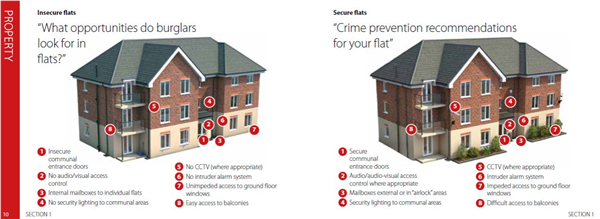 While we will continue to pursue burglars in the area, there are steps you can do to help keep your property safe. Make sure that you: Double lock your door every time you leave the house If you can, move garden furniture or bins away from windows so that thieves cannot use them to gain access. Use laminated glass or security film on ground floor and accessible windows. Use a sash stop if you have sash windows to prevent people opening them enough to climb through. If your windows open outwards, use a key operated lock – check these are locked before leaving the house. Make sure all valuables are out of sight. Keep handbags and keys away from letterboxes or cat flaps. In the evening shut the curtains and leave lights on. Set your burglar alarm Lock your shed or garage Mark, register or record your valuables.
Please go to our website to find the latest advice and guidance on keeping yourself safe. If you ever experience this issue or have information regarding an incident, please report it using our online reporting tools at https://www.met.police.uk/, speak to an operator in our Force Communications Room via our online web chat or call the non-emergency number 101. Get Involved Please consider getting involved and contribute to the local priority survey, we may be unaware of issues that you would like us to focus on. Take a few minutes to securely and privately register and have your say using the button below, this will mean we can focus on things that matter to you. 
Please click here to complete the survey
We are working on our brand-new strategy for how we police London and we want your help. Our New Met for London: Phase 2 strategy will guide how we deliver on behalf of Londoners over the next three years. |