
Op Sceptre Week 16th November (Knife Crime)

|
||
|
|
||
|
||
|
Op Sceptre Week 16th November (Knife Crime) |
||
|
Hello
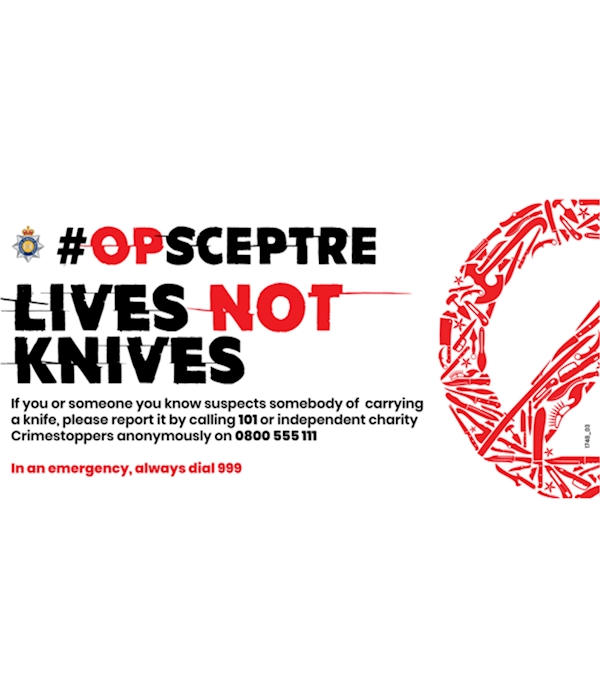
Your Neighbourhood Policing Team will be carrying out a week of action, commencing Monday 16th November. Our teams will be engaging with local communities to tackle knife crime and offer reassurance advice.
Incidents involving knives can have tragic consequences. Knife crime is not a part of everyday life in South Wales, but we recognise the importance of taking action to prevent a problem occurring.
Operation Sceptre is our approach to tackling knife crime, and associated issues of serious violence and illegal drugs.
Our work includes both targeted operations and engagement and education to reassure young people they are safer not carrying knives.
We work alongside partner organisations to support our aims of keeping South Wales safe from knife crime.
If you have suspicions that someone may be carrying a knife, or involved in drugs, you can contact police on 101, or Crimestoppers anonymously on 0800 555111.
Detective Chief Inspector Christine Edmunds said: “Levels of knife offences in the UK have risen over the last few years, and South Wales is no different to anywhere else in that respect.
Know the lawYou may be breaking it without even realising. It’s illegal to: sell a knife to anyone under 18, unless it has a folding blade 3 inches long (7.62 cm) or less carry a knife in public without good reason, unless it has a folding blade with a cutting edge 3 inches long or less carry, buy or sell any type of banned knife use any knife in a threatening way (even a legal knife) Any sharp instrument that is used in a threatening way (e.g. a screwdriver) is also an offensive weapon. Police officers have the right to stop and search any person or vehicle if they suspect an offence, including possession of an offensive weapon. The risk that someone you know may be carrying a knife or may be affected by knife crime can be very worrying and raise many questions.
Advice for parentsThe best way to keep young people safe is to talk to them about the danger. Talking can be difficult, but keep trying. Your son or daughter may be scared or unwilling to talk. Maybe they think they need to carry a knife because they feel threatened. Look out for: Problems at school or a reluctance to go to school Issues of bullying or theft of personal items A new network of friends You may suspect that your son or daughter is carrying a knife. For example, you may discover a knife is missing from the kitchen. Advice for studentsIt is illegal to carry a knife even if it’s for your own protection. Police, and teachers at school, can search anyone suspected of carrying a knife. By carrying a knife, you could get a criminal record or even a prison sentence. This will have an impact on future job prospects and whether you’re able to travel abroad to some countries.
Carrying a knife significantly increases the risk to you being injured. Your own knife can be used against you or someone may attack you in ‘self-defence’.
How would you feel if a younger brother or sister carried a knife because they had seen you do it, and something happened to them as a result?
Using a knife, even in self-defence, can ruin your life as well as someone else’s. Even being there when someone else uses a knife can get you in trouble.
Walk away if you are confronted with the threat of violence. Tell somebody you trust – a parent, teacher, friend or the police.
You can also report anything you know about knife crime 100% anonymously via Fearless.
| ||
Reply to this message | ||
|


|